> For the complete documentation index, see [llms.txt](https://docs.zata.ai/llms.txt). Markdown versions of documentation pages are available by appending `.md` to page URLs; this page is available as [Markdown](https://docs.zata.ai/knowledgebase/integration/connect-bucket-with-cloudberry.md).
# Connect Bucket with CloudBerry
CloudBerry is a cloud-based backup and disaster recovery solution that provide a secure and reliable way to protect data across various platforms. CloudBerry offers a range of products and services, cloud backup, Disaster recovery, cloud storage management, Endpoint Backup.
**Lets connect buckets with CloudBerry**
Download the **CloudBerry** your system to follow these [link.](https://www.msp360.com/explorer/windows/)
After download and completion the installation to open your **CloudBerry**
Add the account to **enable backup and data restoration**.
Click on the file section and click on **Add New account**.
Select the **S3 Compatible**
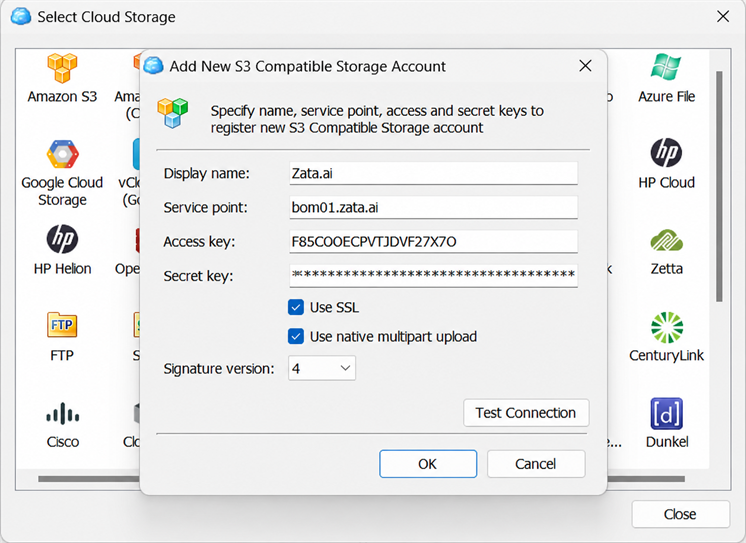
New S3 Compatible Storage Account-
**Display Name :- Specify name**
**Service Point :- idr01.zata.ai** (Central India) or **bom01.zata.ai** (Southern India)
Access and secret key to follow these [link.](https://docs.zata.ai/manage/access-keys/creating-a-new-access-key)
Enter all the details and click on "Test Connection".
The connection was successful. **Click OK.**
The account has been **successfully** added.
Now, back to the **Cloudberry** dashboard, you can see two sections: left and right. The left section shows my local machine and the right section is configured for the **Zata.a**i account.
Go to the right section and click on the source to select the **Zata.ai** account.
After selecting the account **Zata.ai**, we can see our buckets are visible.
If you already have buckets, they will be visible. To create a **bucket**, follow these steps [link.](https://docs.zata.ai/manage/bucket/create-bucket)
Now transferring the data to each other.
Choose the folder in both section, where you want to backup and restore your data.
Here is an example: I selected **`Desktop/New Folder`** my local machine and **Zata.ai** for the bucket.
Now transfer the data by right-clicking the item and selecting **Copy/Move**.
Now we can see data is transferring, here data is transferring depends on your data and internet speed.
Now data have been transferred.