From Wasabi
Copy your buckets from Wasabi to Zata with rclone.
Use rclone to copy objects from a Wasabi bucket to a Zata bucket. rclone reads from Wasabi and writes to Zata in one command. The data passes through the computer that runs rclone.
The Zata settings on this page were tested with rclone v1.75.2 on Zata in October 2026.
Before you start
- A Zata bucket, and a Zata access key from the same region. See Create a bucket and Access keys.
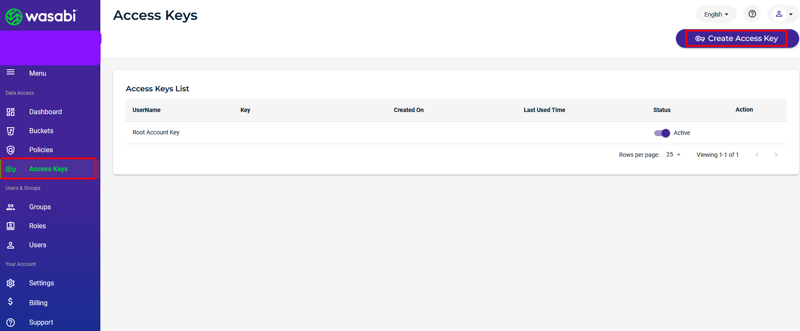
- A Wasabi access key. In the Wasabi console, open Access Keys and select Create Access Key.
- The Wasabi region of the source bucket, for example
ap-northeast-1. You find it in the Wasabi console. - rclone on a computer with a fast internet connection. Install the latest version from rclone.org; on Linux run
curl https://rclone.org/install.sh | sudo bash.
1. Add the Wasabi remote
Replace ap-northeast-1 with the region of your Wasabi bucket, in both places.
rclone config create wasabi s3 provider=Wasabi access_key_id=YOUR_WASABI_ACCESS_KEY secret_access_key=YOUR_WASABI_SECRET_KEY region=ap-northeast-1 endpoint=s3.ap-northeast-1.wasabisys.com
2. Add the Zata remote
For a bucket in Mumbai, use https://bom01.zata.ai as the endpoint.
rclone config create zata s3 provider=Other access_key_id=YOUR_ACCESS_KEY secret_access_key=YOUR_SECRET_KEY region=us-east-1 endpoint=https://idr01.zata.ai force_path_style=true no_check_bucket=true sign_accept_encoding=false
Two of these settings are needed on Zata:
| Setting | Why |
|---|---|
sign_accept_encoding=false | Without it, every command fails with SignatureDoesNotMatch (403). |
no_check_bucket=true | Stops rclone from trying to create the bucket. Needed for sub-user keys. |
To set up the remote step by step instead, see rclone on Linux.
3. Check both remotes
rclone lsd wasabi:
rclone ls zata:my-bucket
The first command lists your Wasabi buckets. The second lists the Zata bucket, and shows nothing while it's empty. With a sub-user key, rclone lsd zata: shows no buckets, so always use the bucket name.
4. Copy the data
Replace my-wasabi-bucket with the Wasabi bucket and my-bucket with the Zata bucket.
rclone copy wasabi:my-wasabi-bucket zata:my-bucket --progress
copynever deletes anything. It skips files that are already the same in Zata, so if it stops halfway, run the same command again.- For a bucket with millions of objects, add
--fast-list --transfers 16 --checkers 32. - If your apps still write to Wasabi during the migration, run the copy again when you switch over to Zata, to pick up the latest files.
5. Check the copy
rclone check wasabi:my-wasabi-bucket zata:my-bucket --one-way
It ends with 0 differences found when every object is in Zata with the same content. Objects uploaded in parts have no MD5 to compare. To compare their content too, add --download (slower, and it downloads the files from Wasabi again).
What rclone doesn't copy
- Old versions. rclone copies the current version of each object only.
- Bucket settings. Versioning, lifecycle rules, bucket policies and Object Lock settings stay in Wasabi. Set them up again in Zata. If you need Object Lock, turn it on when you create the Zata bucket, before you copy: you can't add it later.
Troubleshooting
| Problem | Fix |
|---|---|
SignatureDoesNotMatch or 403 Forbidden on every Zata command | Run rclone config update zata sign_accept_encoding=false (rclone v1.70 or newer; update rclone if older). |
AccessDenied when copying to Zata | Run rclone config update zata no_check_bucket=true. If it still fails, check that the key may write to the bucket. |
InvalidAccessKeyId or NoSuchBucket on Zata | The key, the endpoint and the bucket must all be in the same region. See Wrong endpoint or region. |
| Errors from the Wasabi remote | Check that the Wasabi endpoint matches the bucket's region. |