> For the complete documentation index, see [llms.txt](https://docs.zata.ai/llms.txt). Markdown versions of documentation pages are available by appending `.md` to page URLs; this page is available as [Markdown](https://docs.zata.ai/manage/migration/migrate-from-wasabi-s3-storage-to-zata.ai-s3-storage.md).
# Migrate from Wasabi S3 storage to Zata.ai S3 storage
Wasabi Storage is a cloud-based object storage service that provides high performance, scalability, and cost-effective storage solutions. It is commonly used for backup, disaster recovery, and archiving purposes.
**Prerequisites**
* Select any Linux operating system to perform this process.
* In this setup, **Ubuntu 22.04** is used as the operating system.
* Launch the Ubuntu [Instance](https://docs.neevcloud.com/neevcloud-products/computes/getting-started-launch-vms).
**Setup Wasabi**
* Open the Wasabi login page.
* Log in to the **Wasabi Console** to start the configuration [Wasabi Console.](https://console.wasabisys.com/login)
**Create a Bucket in Wasabi**
* After logging in to the Wasabi Console, navigate to the **Buckets** section.
* Click on **Create Bucket** and complete the bucket creation process by providing the required details.
**Create Access & Secret Key**
* Navigate to the **Access Keys** section in the Wasabi Console.
* Generate a new **Access Key ID** and **Secret Access Key**, and store them securely for later use.
**Setup Zata.ai**
For Zata.ai configuration:
* Open the Zata.ai login page and sign in to your account [login page](https://auth.zata.ai/realms/zata/protocol/openid-connect/auth?client_id=zatacloud_client\&redirect_uri=https%3A%2F%2Fmy.zata.ai%2F\&state=dd2b5305-f7f5-4922-8639-4b0c62060c2f\&response_mode=fragment\&response_type=code\&scope=openid\&nonce=646d8811-0870-469c-9045-9e13d0fdd1b3\&code_challenge=wRG6I1qb9wdmY4unvHhPYaYq5WWM-801w72AYyLi8xY\&code_challenge_method=S256).
* Create a bucket by following the *Zata Bucket Creation Guide* [Bucket Creation Guide](https://docs.zata.ai/manage/bucket/create-bucket)
* Generate the Access Key ID and Secret Access Key by following the *Access Keys Guide* [Access Keys Guid](https://docs.zata.ai/manage/access-keys/creating-a-new-access-key)e
* Refer to the Zata.ai documentation for more detailed information and features [zata.ai](https://zata.ai/)
**Guide to Move Data from Wasabi to Zata.ai**
Ubuntu 22.04 is used as an intermediary system to facilitate the data migration from Wasabi S3 to Zata.ai S3.
**First Process (Wasabi Side Setup)**
* Update and upgrade the Ubuntu system to ensure all packages are up to date.
```
sudo apt-get update -y
sudo apt-get upgrade -y
```
For migrating data from Wasabi to Zata.ai, use **rclone.**
### Install and configure the **rclone.**
```
sudo apt-get install rclone -y
```
**Configure rclone for Wasabi and Zata.ai**
To migrate data, rclone must be configured for both Wasabi and Zata.ai. First configure rclone for Wasabi, and then repeat the same process for Zata.ai.\
\
Run the following command to start the rclone configuration:
```
sudo rclone config
```
When the rclone configuration starts, choose **`n`** to create a new remote.\
Enter **Wasabi** as the name of the remote.
Select **`4`** as the storage type to choose an S3-compatible storage provider.
Note: The option number may vary depending on the rclone version
Choose your S3 Provider to choose '12' for Wasabi object storage, these numbers are very dependent on the rclone versions.
* `env_auth: true` is used to fetch credentials from environment variables.
* This option applies only when `access_key_id` and `secret_access_key` are left blank.
* Setting it to **true** means credentials will be taken automatically from the system environment.
* Setting it to **false** means credentials will be entered manually.
Access & Secret key - We have created the above in the Wasabi section.
* Enter the region to connect to your S3 service.
* If you are using an S3-compatible provider (like Wasabi) and no region is required, leave it blank.
* Press **Enter** to use the default value
Enter the S3 API endpoint for Wasabi (required for S3-compatible storage) and press Enter to continue.
Note that this ACL is applied when server-side copying objects as S3
Note that this ACL is applied only when creating buckets.
After completing these processes, simply press Enter at each step
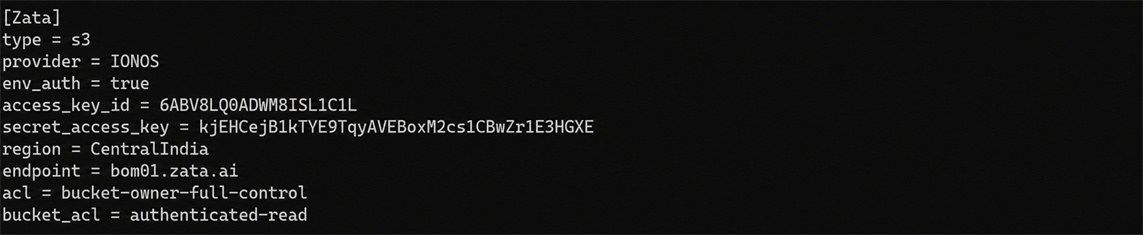
This is the remote configuration completed after following these steps:
Make sure to choose a number these values vary depending on the rclone version.
**Second Process for Zata.ai**
* Repeat the same rclone configuration process for Zata.ai.
* Choose **`n`** to create a new remote.
* Set the remote name as **zata**.
* Choose **`4`** for **S3 Compliant Storage Provider**.
* Choose **`13`** for **S3 Compatible Provider**.
* Set `env_auth` to **true**.
* Enter the **Zata Access Key ID** and **Secret Access Key** (refer to the Access Keys Guide).
* Set the endpoint as per your region:
```
idr01.zata.ai (for Central India / Indore)
bom01.zata.ai (for Southern India / Mumbai)
```
Ensure you have created buckets in both **Wasabi** and **Zata.ai** before running these commands.
After completing the rclone configuration for both Wasabi and Zata.ai, you can start the data transfer process. Use the following command to copy data from the Wasabi bucket to the Zata.ai bucket:
```bash
rclone copy Wasabi: Zata: --s3-region ap-northeast-1 --progress
```
Replace `` with your Wasabi bucket name and `` with your Zata.ai bucket name. The `--progress` option displays the real-time status of the data transfer.
After the migration is completed, return to both the **Wasabi Console** and the **Zata.ai Dashboard** to verify the bucket status and confirm that all data has been transferred successfully.